The Equatorial Electrojet (EEJ) is a narrow ribbon of electric current flowing eastward at ~100 km altitude over the magnetic dip equator — directly above India's southern tip. It forms because the ionosphere at the equator has unusually high electrical conductivity (Cowling conductivity, 5–10× normal), amplifying the normal dynamo current into a concentrated jet ~600 km wide.
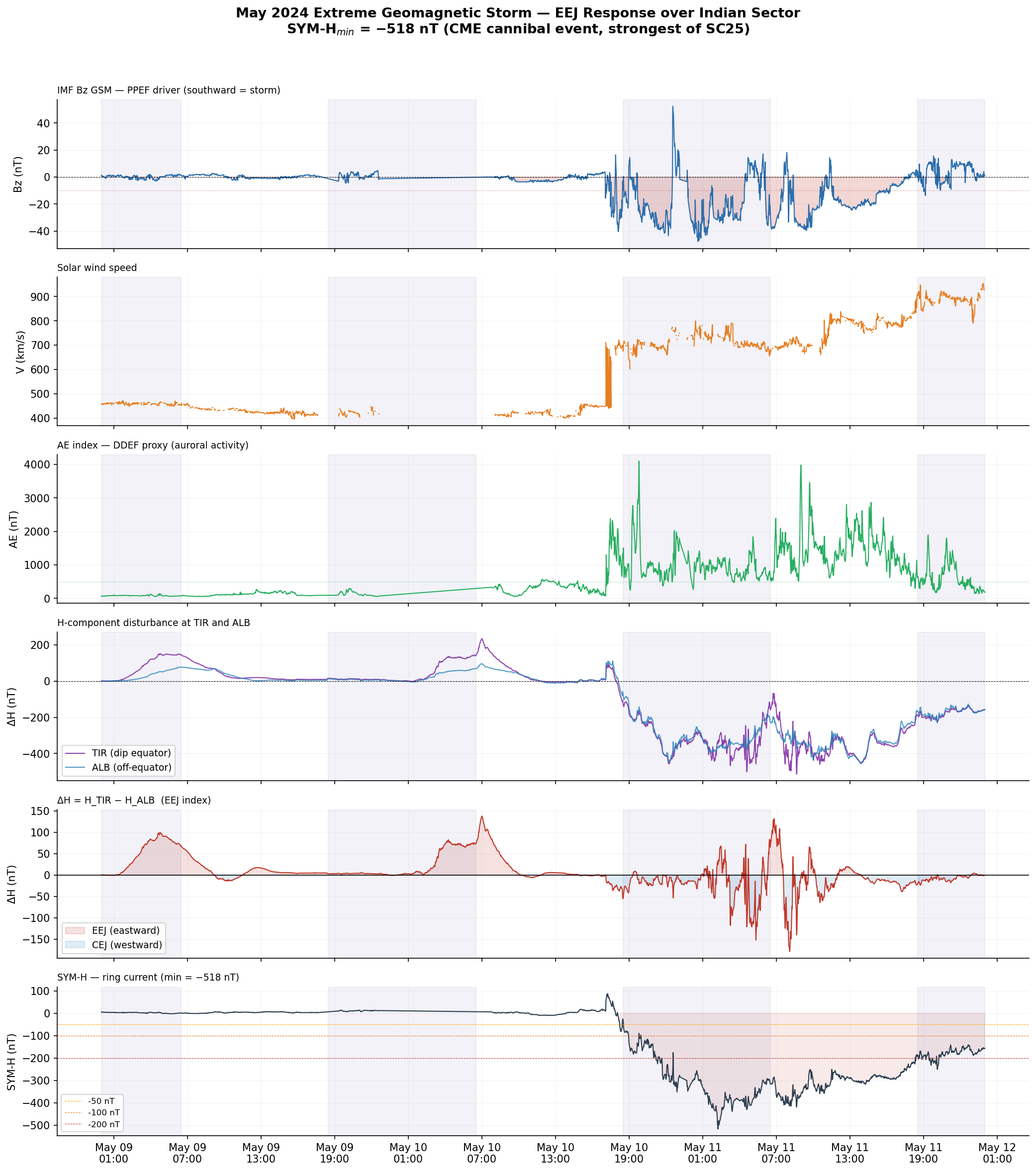
During geomagnetic storms, two competing mechanisms disrupt the EEJ: the Prompt Penetration Electric Field (PPEF) — driven by southward IMF Bz, reaches the equator in 15–20 minutes — and the Disturbance Dynamo Electric Field (DDEF) — driven by auroral heating and thermospheric winds, arrives 4–8 hours later. Their interplay produces the complex EEJ variability seen during extreme storms.
We measure EEJ strength using ΔH = H_TIR − H_ALB: the difference in the horizontal magnetic field between Tirunelveli (on the dip equator) and Alibag (off-equator reference). Positive ΔH = normal eastward EEJ. Negative ΔH = Counter Electrojet (CEJ) — a westward reversal that disrupts HF radio, GPS, and navigation systems across India.
SYM-Hmin = −518 nT · CME cannibal event · Strongest storm of Solar Cycle 25
EEJ_LSTM_v3 — Bi-layer LSTM trained on Solar Cycle 24 storms (2015–2020), evaluated on Solar Cycle 25 (2021–2024). Predicts SYM-H 60 minutes ahead using 2 hours of solar wind context.
⚠ Model trained on SC24. Extreme SC25 events (SYM-H < −300 nT) are outside the training distribution — predictions for such events carry high uncertainty. This is a known limitation and an active research finding.
This project is part of ongoing M.Sc. research by Arpit Mann (IIT JAM 2025 AIR 465, M.Sc. Astronomy). Data: NASA OMNI 1-minute solar wind (2015–2024), IIG magnetometer network (TIR, ABG, HYB, JAI). Target journal: Space Weather (AGU). Contact: [email protected]